heyuan952568@gmail.com
+86 18730808985
Hebei, China
Phone: +86 18730808985
Email: heyuan952568@gmail.com
Contact: zihao zu — Sales Director
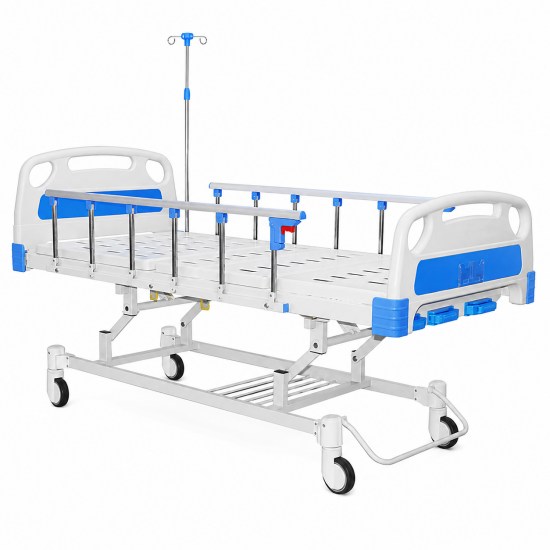
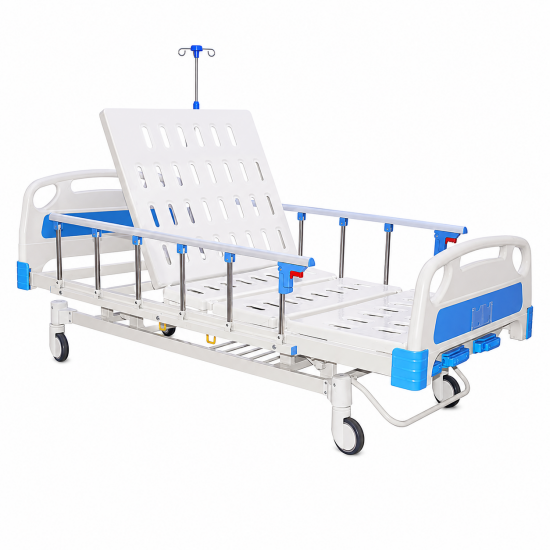
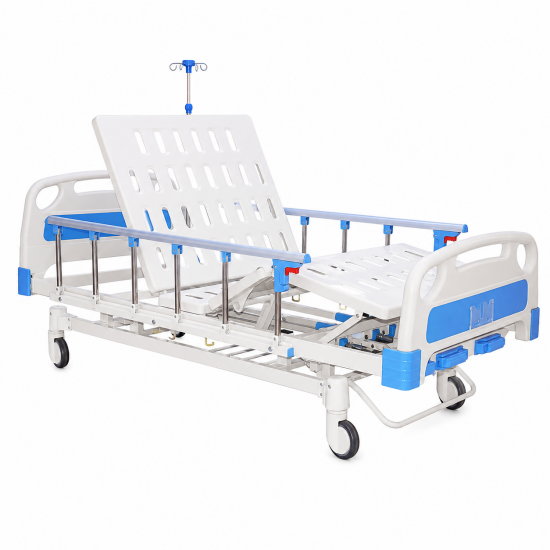
Healthcare and long-term care facilities often need beds that can withstand repeated daily operation while remaining straightforward for caregivers to use and maintain. This three-crank hospital bed combines essential manual positioning with several upgraded features designed around practical institutional use.
Three independent mechanical systems provide backrest adjustment, leg positioning and overall bed height adjustment. Compared with a basic manual three-function model, this configuration adds retractable ABS crank handles, a central braking system and an integrated under-bed storage rack, creating a more complete solution for facilities that prefer manual operation without sacrificing everyday convenience.
The bed is mechanically operated and does not rely on electric actuators for its three primary positioning functions. This makes it particularly relevant for facilities where straightforward operation, predictable maintenance and independence from electrical power are important equipment-selection factors.
The back section can be raised manually to support the patient's upper body. This allows caregivers to provide a more upright position for meals, communication, reading and other routine bedside activities.
A separate crank mechanism controls the leg section, allowing lower-body positioning to be adjusted independently according to patient and care requirements.
The third manual mechanism raises or lowers the complete sleeping platform. Adjustable bed height provides greater flexibility for different bedside care procedures and distinguishes this model from simpler fixed-height or two-function manual beds.
Traditional manual beds frequently use crank handles that remain extended from the foot end. This model adopts retractable ABS handles that can be extended when an adjustment is required and returned to a compact position after operation.
For facilities where caregivers repeatedly move around the bed throughout the day, reducing unnecessary projections can create a cleaner and more practical working area.
The retractable system does not change the fundamental reliability of mechanical adjustment. Instead, it improves how the manual controls are incorporated into the overall bed structure, providing a more refined alternative to conventional exposed crank handles.
Patient beds may need to be repositioned during cleaning, room arrangement, nursing procedures or preparation for patient movement. For this reason, the caster and braking system should be considered an important part of the bed specification rather than simply an accessory.
This model uses a central braking system that allows the bed to be secured through a coordinated locking mechanism. It provides a more convenient approach to mobility management than configurations that rely entirely on separate brakes at individual casters.
In environments where beds are used continuously by rotating care teams, simple and efficient operating features can become increasingly important. Centralized braking helps make routine positioning and securing of the bed more convenient for staff.
The lower frame incorporates a practical storage rack that uses the available space beneath the sleeping platform. Suitable lightweight patient belongings or frequently used care items can be stored without occupying additional floor space beside the bed.
This feature can be particularly useful in multi-bed rooms and long-term care environments where maintaining an organized patient area is an important part of daily facility management.
Side rails provide lateral protection along the sleeping platform during routine use. They can be lowered when caregivers require closer access, supporting different bedside care procedures.
The molded head and foot boards provide a clean medical appearance with smooth surfaces suited to routine cleaning. Their practical construction is intended for repeated handling in institutional healthcare environments.
The sectional sleeping surface moves with the manually operated back and leg mechanisms, allowing the mattress platform to adapt to different patient positions while maintaining continuous support.
The wheeled base supports bed movement within the care environment, while the central brake allows the bed to be secured after reaching the required position.
Electric beds can be appropriate where frequent powered positioning is required, but specifying electric operation for every room may not always match the actual care requirement or project budget.
For residents and patients who need adjustable back, leg and bed-height positions but do not require frequent motorized movement, a well-equipped manual bed can provide a practical alternative.
At the same time, choosing manual operation does not mean that facilities must accept the simplest possible configuration. This model combines mechanical positioning with upgraded mobility, control and storage features.
For buyers comparing products within the Hospital Bed category, this creates a clear step above a conventional basic three-crank model.
Buyers should consider whether the crank handles remain permanently exposed or can be retracted after adjustment. This detail affects how much the controls protrude into the working area around the bed.
Basic caster brakes and a central braking system can provide very different operating experiences in facilities where beds are moved regularly. The braking configuration should therefore be evaluated according to actual ward workflow.
Where bedside space is limited, an integrated lower rack can provide useful additional storage without requiring another piece of furniture immediately beside the bed.
Because the primary adjustments are mechanically operated, the bed does not depend on motors or electrical controls for routine positioning. This can simplify equipment management in projects where electrical functionality is not essential.
The three manual adjustments cover essential positioning requirements, while the upgraded brake and crank configuration supports frequent ward operation.
For extended patient care, the combination of adjustable positioning, practical storage and straightforward mechanical operation provides a functional institutional solution.
The bed can be used where patients require routine positioning assistance but do not need the additional complexity of a fully electric system.
For large-volume projects, the model provides an intermediate specification between basic manual beds and higher-cost electric configurations, allowing buyers to match equipment levels to actual room requirements.
This three-crank hospital bed is designed around a simple principle: retain the reliability of manual positioning while improving the details that affect everyday use. Retractable ABS handles reduce unnecessary protrusions, the central brake improves mobility management, and the under-bed rack adds practical storage.
For nursing institutions, healthcare projects and distributors, these features create a more complete manual hospital bed without introducing unnecessary electrical complexity.
For OEM configurations, bulk purchasing, distributor cooperation or project quotations, please contact us with your required quantity and target-market requirements.

The nursing beds meet our daily care requirements very well. The products arrived in good condition, and the overall purchasing experience was smooth and professional.

We were looking for a supplier that could provide stable quality and flexible OEM service. Their responsiveness and product consistency have helped us grow our business.

The care beds are comfortable, easy to operate, and well received by both residents and caregivers. The team provided helpful support throughout the purchasing process.

We have purchased care beds for several projects, and the product quality has been consistent. Communication was clear, and delivery was arranged on schedule. A reliable supplier to work with.
Yes. We provide OEM and ODM services for care beds, nursing beds, and healthcare furniture, including customization of functions, colors, logos, packaging, and specifications.
Our products are manufactured under ISO 9001 and EN ISO 13485 quality management systems. Specific certifications may vary depending on the product model and market requirements.
Production time depends on the product type and order quantity. Most standard care bed orders can be arranged within the agreed production schedule.
MOQ varies by product model. Please contact us with your requirements, and we will recommend the most suitable purchasing solution.
Yes. We provide product guidance, technical documentation, and responsive after-sales support to help customers use and maintain our care beds efficiently.
Send us your inquiry today and receive product details, quotations, and professional support within 24 hours.
+86 18730808985
Mon-Fri, 8am-6pm CST
heyuan952568@gmail.com
We reply within 24 hours
+86 18730808985
Instant messaging available
Yintai Industrial Park, Jizhou District, Hengshui City, Hebei Province, China
