heyuan952568@gmail.com
+86 18730808985
Hebei, China
Phone: +86 18730808985
Email: heyuan952568@gmail.com
Contact: zihao zu — Sales Director
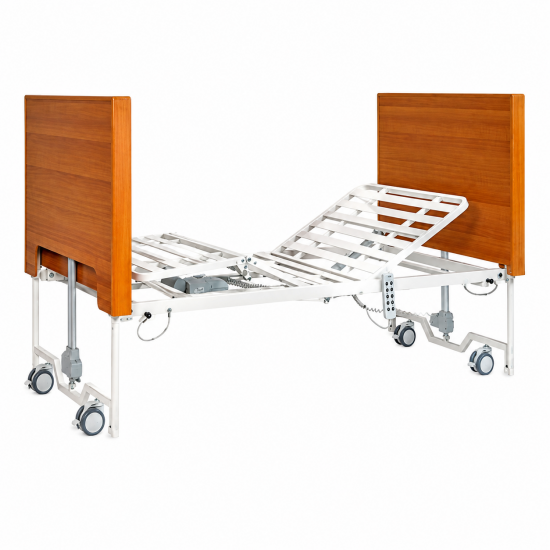
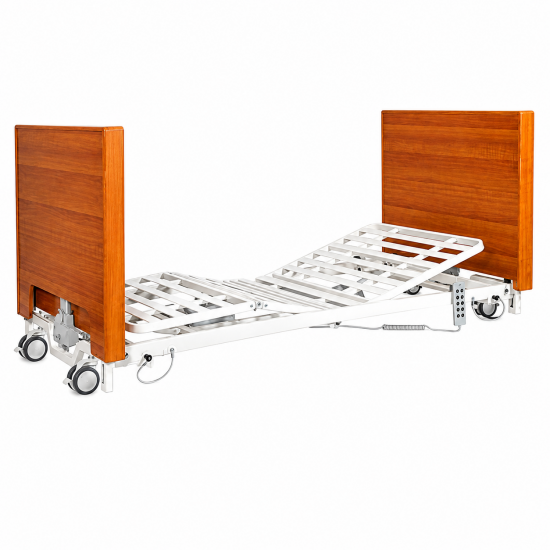
Choosing beds for a nursing home involves more than comparing the number of electric functions. Facilities must consider how low the bed can go during resident rest, whether caregivers can raise it to a practical working height, how much room it requires during adjustment, and how unused beds will be stored.
This ultra-low electric nursing home bed addresses these requirements through a 100–500 mm vertical lifting range, five powered positioning functions and a foldable space-saving structure. At its lowest setting, the mattress platform is approximately 100 mm from the floor. When care is required, the complete bed can be electrically raised to approximately 500 mm.
The combination of ultra-low positioning, vertical hi-low movement and compact folding makes this model particularly suitable for nursing homes, elderly care institutions, assisted living facilities and other long-term residential care environments.
Residents in long-term care can have very different levels of mobility. Some may require regular assistance when entering or leaving the bed, while others may attempt to get up without waiting for a caregiver.
At its minimum position, this bed lowers the sleeping platform to approximately 100 mm above floor level. Reducing the distance between the resident and the floor can help reduce the potential consequences of an accidental bedside fall compared with leaving the sleeping platform at a conventional nursing height.
Side rails are not the only consideration when facilities evaluate beds for residents with elevated fall risk. The ability to lower the entire sleeping surface provides care teams with another positioning option that can be incorporated into an appropriate resident care plan.
The ultra-low function should therefore be viewed as part of a broader care strategy rather than simply another height specification.
A bed positioned only 100 mm from the floor would be impractical for many nursing activities if it remained at that height permanently. This model solves that problem by providing electric whole-bed adjustment up to approximately 500 mm.
Before performing personal care, changing bedding or carrying out other bedside tasks, caregivers can raise the complete sleeping platform to a more accessible working level. After care is completed, the bed can be lowered again according to the resident's requirements.
Because height adjustment is powered, caregivers do not need to manually crank the complete bed between its low and raised positions. This is particularly useful in institutional environments where bed positions may need to be changed repeatedly throughout the day.
The bed uses a vertical lifting structure that moves the platform predominantly upward and downward during height adjustment. This minimizes the horizontal displacement that can occur with some conventional lifting mechanisms.
Nursing home rooms often need to accommodate bedside cabinets, chairs, mobility aids and other resident belongings. A bed that requires substantial additional longitudinal space while changing height can complicate room planning.
By maintaining a more consistent footprint during lifting, this model can be positioned more predictably alongside surrounding furniture and equipment.
The back section can be electrically adjusted from approximately 0° to 75° ±5°. Residents can be progressively moved from a flat resting position toward a supported upper-body position for meals, reading, conversation and other everyday activities.
The knee section provides approximately 0° to 40° ±5° of powered adjustment. It can be used independently or together with the backrest to create different supported resting configurations.
The complete mattress platform travels between approximately 100 and 500 mm. The wide adjustment range is one of the main characteristics separating this model from conventional electric nursing beds.
The whole platform provides approximately 0° to 12° ±2° of Trendelenburg adjustment, providing additional positioning flexibility for use according to facility care procedures.
Reverse Trendelenburg movement of approximately 0° to 12° ±2° tilts the complete platform in the opposite direction. Together with the back and knee adjustments, this creates a versatile five-function electric positioning system.
Nursing homes do not always use every available bed continuously. Changes in occupancy, room renovation, equipment replacement and temporary care requirements can leave beds unused for certain periods.
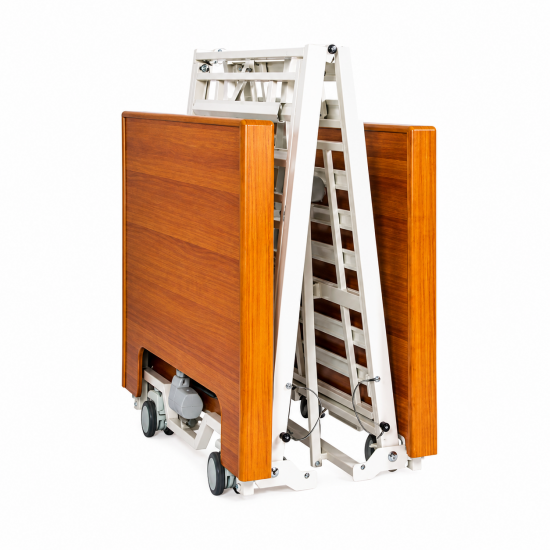
A conventional nursing bed still occupies its complete footprint during storage. This model can be folded into a much more compact configuration when it is temporarily removed from service.
For facilities maintaining several spare units, foldability can help reduce the floor area required for equipment storage and make reserve-bed organization more manageable.
Care organizations operating several locations may periodically move equipment between facilities according to occupancy and operational requirements. A compact folding structure can make inactive beds easier to manage during storage and internal equipment allocation.
The same advantage applies to medical equipment distributors and rental providers. When multiple beds are waiting for delivery or redeployment, reducing the storage footprint of each unit can improve warehouse space utilization.
Hospital beds are generally designed primarily for clinical environments, but nursing home residents may live with the same bed for an extended period. For this reason, appearance becomes an important consideration alongside functionality.
This model uses large wood-finish head and foot panels to create a warmer visual character than a conventional hospital-style bed. The design helps professional care equipment integrate more naturally into residential interiors.
The combination of professional electric positioning and a less institutional exterior makes the bed appropriate for nursing homes, assisted living communities, senior residences and other facilities seeking a more home-like resident environment.
The adjustable functions are powered by four electric actuators. A wired handset provides centralized control of the bed movements, allowing caregivers to change positions without manual crank operation.
The primary structural components use epoxy-coated steel, providing a stable framework for repeated electric positioning and height adjustment in long-term care environments.
The mattress support structure is divided into adjustable sections corresponding to the backrest and knee-rest movements. Its steel construction provides a durable supporting surface for repeated everyday use.
Four double-sided casters allow caregivers to reposition the bed when necessary. Individual braking mechanisms secure the casters once the bed has reached the required location.
Do not compare beds only by maximum lifting height. For facilities considering low-bed strategies, the minimum platform position can be one of the most important specifications. This model reaches approximately 100 mm.
Two beds with similar minimum and maximum heights may move very differently. A vertical lifting mechanism can reduce unnecessary horizontal movement and make the bed easier to integrate into a planned room layout.
Backrest and knee adjustment cover common everyday positions, while Trendelenburg and reverse Trendelenburg functions provide additional whole-bed positioning capability.
For bulk procurement, buyers should also consider where spare beds will be kept. A foldable model may provide a meaningful operational advantage when multiple units need to be stored.
For long-term residential environments, wood-finish panels can help create a warmer atmosphere than conventional hospital-style head and foot boards.
Approximately 2240 × 900 mm.
Approximately 100–500 mm with electric vertical lifting.
Approximately 0°–75° ±5°.
Approximately 0°–40° ±5°.
Approximately 0°–12° ±2°.
Approximately 0°–12° ±2°.
Four electric actuators with wired handset control.
Epoxy-coated steel frame and articulated mattress platform.
Residential-style wood-finish panels.
Four double-sided casters with individual braking mechanisms.
Foldable bed frame designed to reduce the storage footprint when the unit is not in active use.
This model is not simply a conventional electric nursing bed with a lower frame. Its design connects several practical requirements encountered in long-term institutional care: approximately 100 mm ultra-low resident positioning, electric lifting to approximately 500 mm for caregiver access, near-vertical height movement for predictable room placement and a foldable structure for more efficient equipment storage.
These features provide nursing home buyers with a clearly differentiated option within the Nursing Bed category, particularly for projects where resident care, caregiver workflow and long-term equipment management all need to be considered.
For nursing home projects, bulk purchasing, OEM configurations or distributor cooperation, please contact us with your required quantity and target-market requirements.

The nursing beds meet our daily care requirements very well. The products arrived in good condition, and the overall purchasing experience was smooth and professional.

We were looking for a supplier that could provide stable quality and flexible OEM service. Their responsiveness and product consistency have helped us grow our business.

The care beds are comfortable, easy to operate, and well received by both residents and caregivers. The team provided helpful support throughout the purchasing process.

We have purchased care beds for several projects, and the product quality has been consistent. Communication was clear, and delivery was arranged on schedule. A reliable supplier to work with.
Yes. We provide OEM and ODM services for care beds, nursing beds, and healthcare furniture, including customization of functions, colors, logos, packaging, and specifications.
Our products are manufactured under ISO 9001 and EN ISO 13485 quality management systems. Specific certifications may vary depending on the product model and market requirements.
Production time depends on the product type and order quantity. Most standard care bed orders can be arranged within the agreed production schedule.
MOQ varies by product model. Please contact us with your requirements, and we will recommend the most suitable purchasing solution.
Yes. We provide product guidance, technical documentation, and responsive after-sales support to help customers use and maintain our care beds efficiently.
Send us your inquiry today and receive product details, quotations, and professional support within 24 hours.
+86 18730808985
Mon-Fri, 8am-6pm CST
heyuan952568@gmail.com
We reply within 24 hours
+86 18730808985
Instant messaging available
Yintai Industrial Park, Jizhou District, Hengshui City, Hebei Province, China
