heyuan952568@gmail.com
+86 18730808985
Hebei, China
Phone: +86 18730808985
Email: heyuan952568@gmail.com
Contact: zihao zu — Sales Director
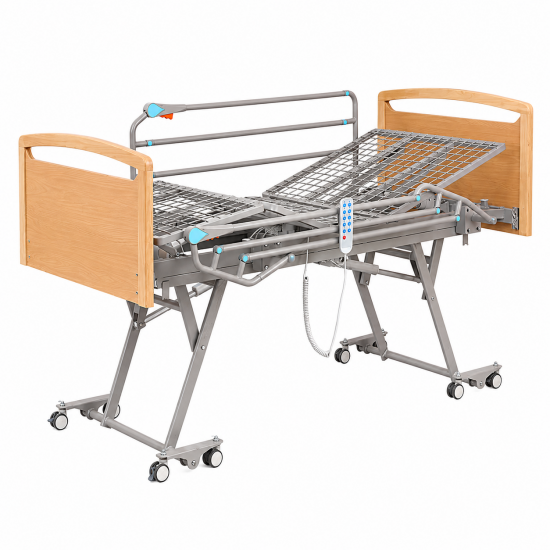
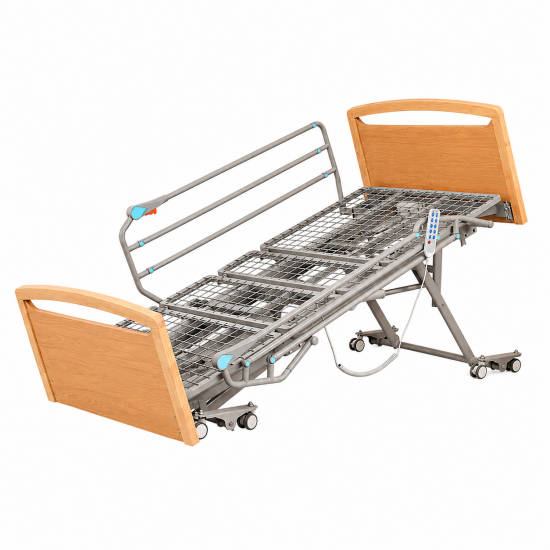
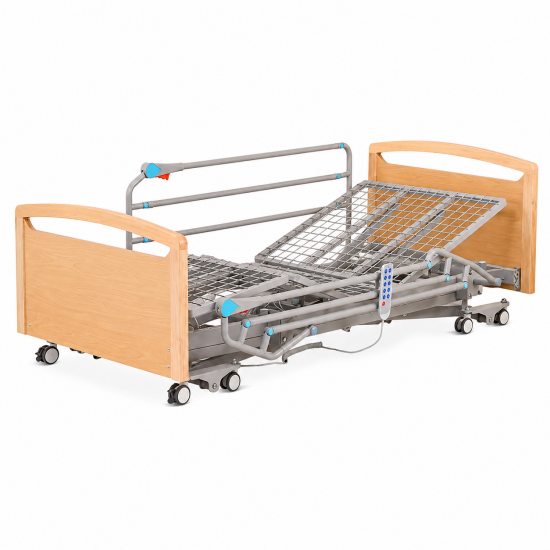
In a nursing home, the ideal bed height can change several times during the same day. A lower mattress position may be preferred while a resident is resting, while personal care, repositioning and bedding changes may require the platform to be raised substantially higher for caregiver access.
This electric 5-function nursing home bed is designed around that daily care cycle. The complete mattress platform can be adjusted from approximately 230 mm to 700 mm above floor level, providing around 470 mm of electric height travel between its lowest and highest positions.
Rather than focusing exclusively on achieving the lowest possible bed height, this model balances low-level resident positioning with a higher caregiver working position. Electric backrest, knee-rest, Trendelenburg and reverse Trendelenburg adjustments further expand its use in nursing homes and long-term care facilities.
At its minimum setting, the mattress platform can be lowered to approximately 230 mm from the floor. This gives care teams the option of maintaining a considerably lower sleeping surface than a conventional fixed-height nursing bed.
For selected elderly residents with reduced mobility or an increased risk of bedside falls, reducing bed height may form part of a broader individualized fall-risk management strategy determined by the care facility.
Side rails, supervision, room layout and resident mobility all need to be considered when managing bedside safety. A low bed does not replace these measures, but adjustable height gives caregivers another way to configure the resident's environment according to individual requirements.
The requirements change when caregivers begin working directly around the resident. Leaving the mattress platform at approximately 230 mm during every nursing activity would make the low position impractical for frequent hands-on care.
For this reason, the complete platform can be electrically raised to approximately 700 mm. Caregivers can select a higher position before carrying out activities such as changing bedding, assisting with repositioning, dressing or other routine personal care.
The approximately 470 mm difference between the minimum and maximum positions gives care teams considerable flexibility. Rather than adapting every nursing task to one fixed bed height, staff can adjust the platform according to the activity being performed.
When purchasing low nursing beds, it is easy to compare products only by asking which model reaches the smallest minimum height. For long-term institutional use, however, this does not provide the complete picture.
A nursing home bed must serve both the resident and the people providing care. A very low minimum position may be useful during rest, while adequate maximum height becomes important when staff repeatedly work around the mattress platform.
The lower end of the adjustment range provides a low-level configuration for periods when reduced mattress height is preferred.
The upper end provides a significantly higher working level for routine nursing activities.
For procurement teams, this complete adjustment range is one of the most important specifications distinguishing the model from conventional low-height care beds.
The back section can be raised electrically to change the resident from a flat position toward a more upright posture. This provides different positions for meals, conversation, reading, television viewing and other everyday activities.
In long-term care, bed positions may be changed repeatedly rather than only during occasional medical procedures. Electric operation allows caregivers to make these adjustments without using manual crank mechanisms.
The knee section can be elevated independently to provide additional lower-body positioning. It can also be combined with backrest elevation to create different supported resting positions.
The complete sleeping platform moves electrically between approximately 230 and 700 mm, allowing caregivers to select the required height for different stages of daily care.
The entire mattress platform can be electrically tilted into a Trendelenburg position, providing an additional whole-bed positioning option.
The platform can also tilt in the opposite direction to create a reverse Trendelenburg position. Together with backrest, knee-rest and height adjustment, these movements form the five-function electric system.
When a lower mattress level is considered appropriate for the resident, the bed can be moved toward its approximately 230 mm minimum position.
Before personal care or bedding changes, staff can raise the complete platform to a more accessible working height.
The backrest and knee sections can be adjusted to create different supported positions according to the resident's daily routine.
When direct access is required, the side rails can be lowered and the mattress platform positioned at a height suitable for the activity being performed.
This ability to move between different heights and mattress positions is especially valuable in nursing homes, where the same bed may be used continuously for long periods and must accommodate many different care activities every day.
Long side rails provide protection along a substantial portion of the mattress platform when raised. Their configuration is suitable for long-term care environments where resident mobility can vary considerably.
The rails can be lowered when caregivers require closer bedside access. This allows the bed to transition between a protected resting configuration and a more open nursing configuration.
Nursing home residents may use the same bed and room for an extended period, making appearance more relevant than it is in many short-term hospital environments.
The wooden-finish head and foot panels give this model a warmer visual character than a conventional clinical bed with predominantly plastic medical panels.
The residential-style exterior allows the bed to coordinate more naturally with bedside cabinets, wardrobes and other furniture commonly used in nursing home and senior living rooms.
This helps facilities combine professional electric care functions with a less institutional living environment.
The wide height range supports both low-level resident positioning and elevated caregiver access during repeated daily nursing activities.
Five electric functions allow the bed configuration to be adapted as resident mobility and care requirements change.
The combination of electric positioning and residential styling is suitable for facilities that need additional care functionality without creating an excessively clinical room appearance.
Multiple powered positions provide flexibility for residents whose mobility and preferred resting positions may change during extended recovery periods.
For organizations purchasing multiple beds, the 230–700 mm height range provides a clear specification for differentiating this model from standard electric nursing beds and lower models with more limited upward adjustment.
An ultra-low model capable of reaching approximately 100 mm is particularly relevant where minimizing the distance between the sleeping platform and the floor is the primary purchasing objective. If the model also folds, compact storage can become another important advantage.
This bed follows a different design philosophy. Although its 230 mm minimum height is higher than a 100 mm floor-level model, it can rise substantially higher to approximately 700 mm.
The result is approximately 470 mm of usable height travel, making this model particularly relevant to nursing homes where caregivers frequently need to move between low resident positions and elevated working positions.
For procurement teams, neither configuration is automatically better. A 100 mm model may be preferred when extreme low-level positioning is the priority, while the 230–700 mm model may be more appropriate when a wider transition between resident height and caregiver working height is required.
Electric 5-function low-level nursing home bed.
Approximately 230 mm from floor level.
Approximately 700 mm from floor level.
Approximately 470 mm.
Electric upper-body positioning.
Electric lower-body positioning.
Electric whole-bed height adjustment from approximately 230 to 700 mm.
Electric Trendelenburg and reverse Trendelenburg positioning.
Handheld electric controller.
Long foldable side rails for resident protection and caregiver access.
Wooden-finish design suitable for residential long-term care environments.
Nursing homes, elderly care facilities, assisted living communities, rehabilitation centers and long-term residential care institutions.
A nursing home bed is used by two groups every day: the resident who sleeps and lives around it, and the caregiver who repeatedly works around it. This model is designed to address the needs of both.
The approximately 230 mm low position provides a reduced mattress height when appropriate for the resident, while the approximately 700 mm maximum height gives caregivers a substantially higher working position. Between these two extremes, electric adjustment allows the facility to select the height that best matches each care activity.
Combined with five powered positioning functions, long side rails and residential wooden styling, this model provides a differentiated option within our Nursing Bed range for professional nursing home and long-term care projects.
For nursing home projects, bulk procurement, OEM configurations or distributor cooperation, please contact us for detailed specifications and quotation information.

The nursing beds meet our daily care requirements very well. The products arrived in good condition, and the overall purchasing experience was smooth and professional.

We were looking for a supplier that could provide stable quality and flexible OEM service. Their responsiveness and product consistency have helped us grow our business.

The care beds are comfortable, easy to operate, and well received by both residents and caregivers. The team provided helpful support throughout the purchasing process.

We have purchased care beds for several projects, and the product quality has been consistent. Communication was clear, and delivery was arranged on schedule. A reliable supplier to work with.
Yes. We provide OEM and ODM services for care beds, nursing beds, and healthcare furniture, including customization of functions, colors, logos, packaging, and specifications.
Our products are manufactured under ISO 9001 and EN ISO 13485 quality management systems. Specific certifications may vary depending on the product model and market requirements.
Production time depends on the product type and order quantity. Most standard care bed orders can be arranged within the agreed production schedule.
MOQ varies by product model. Please contact us with your requirements, and we will recommend the most suitable purchasing solution.
Yes. We provide product guidance, technical documentation, and responsive after-sales support to help customers use and maintain our care beds efficiently.
Send us your inquiry today and receive product details, quotations, and professional support within 24 hours.
+86 18730808985
Mon-Fri, 8am-6pm CST
heyuan952568@gmail.com
We reply within 24 hours
+86 18730808985
Instant messaging available
Yintai Industrial Park, Jizhou District, Hengshui City, Hebei Province, China
