heyuan952568@gmail.com
+86 18730808985
Hebei, China
Phone: +86 18730808985
Email: heyuan952568@gmail.com
Contact: zihao zu — Sales Director
Most residents in nursing homes and long-term care facilities can be supported with conventional electric nursing beds designed for sleeping, backrest positioning, leg adjustment and routine daily care. However, residents participating in more advanced mobility and rehabilitation programs may require equipment capable of providing additional whole-body positioning and progressive upright support.
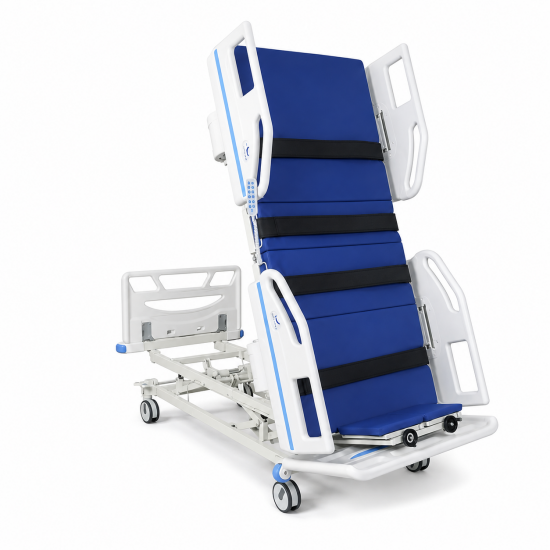
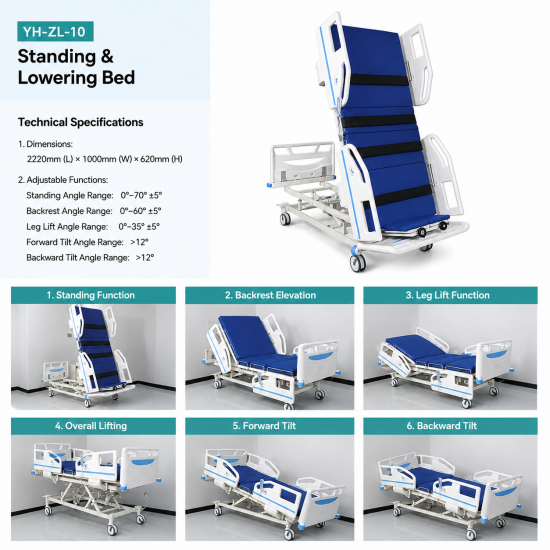
This advanced electric standing rehabilitation bed is designed for that higher level of care. It combines progressive standing from 0° to 70° ±5° with electric backrest adjustment, leg elevation, whole-bed height adjustment and forward/backward tilt. These functions allow the platform to support both routine positioning and professionally supervised rehabilitation activities.
For nursing home procurement, choosing one bed specification for every resident is not always the most efficient approach. Residents with relatively stable mobility needs may be appropriately supported by a conventional Nursing Bed, while those requiring progressive upright positioning may benefit from a more specialized rehabilitation configuration.
This model is intended to fill that second role. Rather than replacing standard nursing beds throughout a facility, it can be deployed selectively in rehabilitation rooms or for residents whose care programs require more extensive positioning capability.
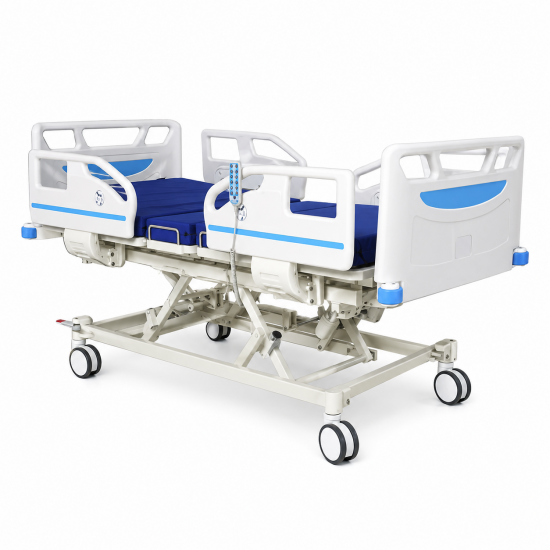
The bed remains useful when standing rehabilitation is not being performed. Independent back and leg movements provide practical positions for routine resident care, while the advanced whole-bed functions can be used when additional rehabilitation positioning is required.
The complete patient support platform can be electrically raised from a horizontal position toward an upright angle of up to 70° ±5°. The movement is progressive, allowing intermediate angles to be selected during supervised rehabilitation procedures.
Standing rehabilitation is not simply a choice between lying flat and reaching the maximum upright angle. Different users may require different intermediate positions according to their individual rehabilitation programs. Electric adjustment gives professional staff greater control over this transition.
Multiple adjustable body support straps are incorporated into the platform to provide additional stabilization as the bed moves toward an upright position.
A dedicated foot-end support surface also provides support at the lower end of the platform during standing procedures. These features form an important part of the overall standing configuration.
The electrically operated backrest allows residents to move from a flat position toward supported upper-body elevation. This position can be useful during meals, communication, reading and routine nursing activities.
The leg section can be adjusted independently from 0° to 35° ±5°. It can also be combined with backrest movement to provide different supported positions according to resident and caregiver requirements.
Because back and leg positioning are incorporated into the same platform, the equipment remains functional throughout the day rather than serving only as a standing training device.
Caregivers in long-term care facilities repeatedly assist residents with positioning and routine bedside activities. This model includes electric whole-bed lifting and lowering so that the complete support platform can be adjusted according to different care and rehabilitation requirements.
The standing mechanism changes the orientation of the resident toward an upright position, while whole-bed height adjustment changes the working level of the entire platform. Having both functions provides greater operational flexibility than a basic fixed-height standing bed.
The available product specifications confirm electric height adjustment but do not provide the minimum and maximum height range, so exact lifting dimensions should be confirmed according to the ordered configuration.
The complete platform can tilt forward by more than 12°. This movement changes the orientation of the whole bed rather than simply adjusting the back or leg section.
Backward tilt of more than 12° is also available, providing bidirectional whole-platform positioning for professional care and rehabilitation applications.
The bidirectional whole-bed tilt provides Trendelenburg and reverse Trendelenburg type positioning capability, expanding the range of positions available to professional care teams.
The bed is equipped with segmented ABS side rails around the support platform. They provide lateral protection during routine use while allowing the articulated bed sections to move through different positions.
The wheeled chassis allows staff to reposition the equipment within the care environment when necessary. The bed should be properly secured before patient positioning and rehabilitation procedures according to facility operating protocols.
Electric operation reduces reliance on manual mechanical adjustments and allows care teams to control multiple bed movements more conveniently during repeated daily use.
2220 mm (L) × 1000 mm (W) × 620 mm (H).
0°–70° ±5°.
0°–60° ±5°.
0°–35° ±5°.
Electric whole-bed lifting and lowering.
Greater than 12°.
Greater than 12°.
Multi-point adjustable support straps, foot-end standing support and protective ABS side rails.
If the primary requirement is sleeping, sitting assistance and everyday nursing care, a conventional nursing bed may be more appropriate. The main reason to select this model is the requirement for progressive upright positioning as part of a supervised rehabilitation program.
For facilities requiring only tilt-up standing, a simpler Standing Bed may meet the project requirement at a lower configuration level.
This advanced model becomes more relevant when standing needs to be combined with whole-bed lifting, forward/backward tilt and independent back and leg positioning.
If the resident remains on the same platform between rehabilitation sessions, the additional backrest, leg and height adjustments increase the practical value of the equipment throughout the day.
Suitable for facilities that provide both long-term residential care and supervised mobility rehabilitation within the same institution.
The multiple electric positions provide greater flexibility for residents whose care requirements extend beyond conventional bed positioning.
The 70° ±5° progressive standing capability combined with whole-bed adjustment makes this configuration suitable for structured rehabilitation environments serving older adults.
Facilities combining medical support, nursing and rehabilitation services can use this model as a specialized addition to their standard nursing bed inventory.
For distributors and project buyers, this advanced standing bed should not be positioned as a replacement for every nursing bed. It is better treated as a specialized rehabilitation model within a broader elderly care equipment portfolio.
A facility can combine standard electric nursing beds for routine resident care, lower-specification standing beds for basic upright training, and this advanced model for users requiring greater positioning flexibility. This creates a clearer equipment hierarchy and allows purchasing decisions to be matched to actual care requirements.
Explore additional configurations in our Standing Bed category, or contact us for OEM options, distributor cooperation, bulk purchasing and project quotations.

The nursing beds meet our daily care requirements very well. The products arrived in good condition, and the overall purchasing experience was smooth and professional.

We were looking for a supplier that could provide stable quality and flexible OEM service. Their responsiveness and product consistency have helped us grow our business.

The care beds are comfortable, easy to operate, and well received by both residents and caregivers. The team provided helpful support throughout the purchasing process.

We have purchased care beds for several projects, and the product quality has been consistent. Communication was clear, and delivery was arranged on schedule. A reliable supplier to work with.
Yes. We provide OEM and ODM services for care beds, nursing beds, and healthcare furniture, including customization of functions, colors, logos, packaging, and specifications.
Our products are manufactured under ISO 9001 and EN ISO 13485 quality management systems. Specific certifications may vary depending on the product model and market requirements.
Production time depends on the product type and order quantity. Most standard care bed orders can be arranged within the agreed production schedule.
MOQ varies by product model. Please contact us with your requirements, and we will recommend the most suitable purchasing solution.
Yes. We provide product guidance, technical documentation, and responsive after-sales support to help customers use and maintain our care beds efficiently.
Send us your inquiry today and receive product details, quotations, and professional support within 24 hours.
+86 18730808985
Mon-Fri, 8am-6pm CST
heyuan952568@gmail.com
We reply within 24 hours
+86 18730808985
Instant messaging available
Yintai Industrial Park, Jizhou District, Hengshui City, Hebei Province, China
